Whether you join us annually at the Arbor Day Tree Giveaway in The Woodlands or are buying saplings from one of the many sales this time of year, here are some great resources to ensure your trees thrive for years to come.
See the list below for quick overview of what you’ll find in this post. Click on a category to jump to that section or simply scroll through for all the tree care tips.
Planting Bare-root Trees
Mulching the Right Way
3 Great Pruning Resources
Right Tree Right Place
Find a Certified Arborist Near You
Arbor Day Varieties
Which Tree is Good For Me? Guide to Arbor Day Varieties
Detailed Links for Each Variety
Planting Bare-root Trees video
How to Plant Bare-root Trees
Provided by Arbor Day Foundation®
-
Unpack your trees, remove all packing materials, carefully untangle the roots and soak the roots in water 3 to 6 hours. Do not allow the roots to dry out.
-
Dig a hole, wider than seems necessary, so the roots can grow outward without crowding. Remove any grass within a 3-foot circular area. To aid root growth, turn soil in an area up to 3 feet in diameter.
-
Plant the tree at the same depth it stood in the nursery, with plenty of room for the roots. Partially fill the hole, .firming the soil around the lower roots. Do not add soil amendments such as peat or bark. Do not use fertilizer, potting soil, or chemicals on your new trees.
-
Shovel in the remaining soil. It should be firmly but not tightly packed. Construct a water-holding basin around the tree. Give the tree plenty of water.
-
After the water has soaked in, spread protective mulch two inches deep in a 3-foot diameter area around the base of the tree, but not touching the trunk.
-
The soil and mulch around your trees should be kept moist but not soggy. During dry weather, generously water the tree every 7 to 10 days during the first year. Water slowly at the dripline
View and print the visual guide(PDF, 289KB)
For a step-by-step guide to successfully plant your bare-root tree, visit the Arbor Day Foundation website.
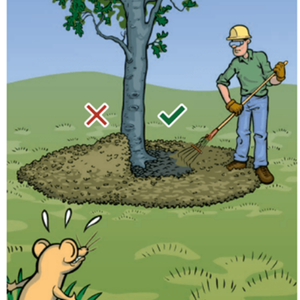 Cartoon depiction of a mouse watching as a man spreads mulch out correctly, with the other side of the tree marked with an X and mounded mulch
After you plant, there’s one more step! Adding native mulch is one of the best things you can do to keep moisture in the soil while adding organic matter as it breaks down. There is a right and a wrong way to mulch; check out this simple guide to make sure you are helping the tree, not harming it.
Check out this quick guide to mulching right from the Arborists themselves or watch the video below from the Tree Care Video Library.
Mulching is also important to avoid conflicts between trees and turf grass. Find out why here.
Ask an Arborist: Why Do We Mulch? video
-
This Tree City USA bulletin covers how to prune young shade trees. Follow the story of two families who both plant trees, and how those trees turn out in 15 years. Look at the final shape of the tree below, isn’t it a thing of beauty? It is the result of judicious pruning throughout the tree’s life.
 Depictions of a tree at planting, 3 years, 5 years, and 15 years after planting
-
A quick guide to correct pruning is found in this this ISA Guide to Pruning Young Trees. Proper pruning is essential to creating a tree with a strong structure and pleasing form.
-
Are you wondering what some of the common mistakes are? This USDA Forest Service Guide has helpful pictures of what to avoid, as well as how to do it right.
Even if you plant the tree correctly, mulch it well, and prune it for a strong structure, it won’t matter much if the tree is in the wrong place to begin with. One of the essential functions of trees in southeast Texas is to provide cooling summer shade. Think about that function and other factors that affect tree placement in this visual guide to determining the right Tree for the right place.
Use the information to select the best tree for your site.
-
Loblolly Pine reaches 80 by 25 feet in its mature size. The species requires full sun and low watering. Loblolly Pine provides food for small mammals, birds and serves as a host to future butterflies and moths.
-
Black Walnut reaches 50 by 30 feet in its mature size. The species requires part to full sun and high watering. Black Walnut provides food for nectar lovers, small mammals, birds and serves as a host to future butterflies and moths.
-
American Sycamore reaches 90 to 60 feet in its mature size. The species requires full sun and low watering. American Sycamore blooms yellow and green flowers. Its leaves change color in the fall season. American Sycamore provides food for birds and serves as a host to future butterflies and moths.
-
Green Ash reaches 50 by 25 feet in its mature size. The species requires full sun and low watering. Its leaves change color in the fall season. Green Ash provides food for small mammals and birds.
-
Live Oak reaches 70 by 70 feet in its mature size. The species requires part to full sun and moderate watering. Live Oak blooms yellow flowers and its leaves change color in the fall season. The species provides food for nectar lovers, small mammals, birds and serves as a host to future butterflies and moths.
-
Pignut Hickory reaches 70 by 50 feet in its mature size. The species requires part to full sun and high watering. Pignut Hickory blooms green and yellow flowers, and its leaves changing color in the fall season. The species provides food for nectar lovers, small mammals, birds and serves as a host to future butterflies and moths.
-
Black Cherry reaches 50 by 30 feet in its mature size. The species requires part to full sun and moderate watering. Black Cherry blooms white flowers and it fruits in the fall season. The species provides food for nectar lovers, small mammals, birds and serves as a host to future butterflies and moths.
-
Flowering Dogwood reaches 30 by 25 feet in its mature size. The species requires part sun and low watering. Flowering Dogwood blooms white flowers. In the fall season, its leaves change color and fruit. The species provides food for nectar lovers, small mammals, birds and serves as a host to future butterflies and moths.
-
Witch Hazel reaches 15 by 10 feet in its mature size. The species requires part to full sun and low watering. Witch Hazel blooms yellow, fragrant flowers. In the fall, its leaves and flowers change color. The species provides food for nectar lovers, small mammals and birds.
-
Eastern Redbud reaches 20 by 15 feet in its mature size. The species requires part sun and moderate watering. Eastern Redbud blooms pink flowers and its leaves change color in the fall season. The species provides food for nectar lovers, small mammals, birds and serves as a host to future butterflies and moths.
-
Shagbark Hickory reaches 70 by 50 feet in its mature size. The species requires part to full sun and moderate watering. Shagbark Hickory blooms green flowers and its leaves change color in the fall season. The species provides food for nectar lovers, small mammals, birds and serves as a host to future butterflies and moths.
-
False Indigo reaches 10 by 10 feet in its mature size. The species requires part to full sun and moderate watering. False Indigo blooms purple and dark blue flowers and its leaves change color in the fall season. The species provides food for nectar lovers, birds and serves as a host for future butterflies and moths.
View and print visual guide(PDF, 116KB)
I need a large tree that is...
-
Drought-tolerant
-
Loblolly Pine
-
American Sycamore
-
Green Ash
-
Fast-growing
-
Loblolly Pine
-
Black Walnut
-
Green Ash
I want fall color...
-
Big trees
-
Black Walnut
-
American Aycamore
-
Green Ash
-
Live Oak
-
Pignut Hickory
-
Small trees
-
Flowering Dogwood
-
Witch Hazel
-
Eastern Redbud
-
False Indigo
I need a small tree for...
-
Full Sun
-
Black Cherry
-
Witch Hazel
-
False Indigo
-
Part sun
-
Black Cherry
-
Flowering Dogwood
-
Witch Hazel
-
Eastern Redbud
-
False Indigo
-
Low water
-
Flowering Dogwood
-
Witch Hazel
I want to feed pollinators
-
Host plants - the leaves feed caterpillars that become butterflies or moths
-
Loblolly Pine
-
Black Walnut
-
American Sycamore
-
Live Oak
-
Pignut Hickory
-
Black Cherry
-
Flowering Dogwood
-
Eastern Redbus
-
Shagbark Hickory
-
False Indigo
-
These plants produce nectar that attract bees, butterflies & other nectar-lovers
-
Black Walnut
-
Live Oak
-
Pignut Hickory
-
Black Cherry
-
Flowering Dogwood
-
Witch Hazel
-
Eastern Redbud
-
Shagbark Hickory
-
False Indigo
View and print visual guide(PDF, 165KB)
Check out the links below for in-depth information from the Ladybird Johnson Wildflower Center’s Native Plant Database below.
LARGE CANOPY TREES
Loblolly Pine (Pinus taeda)
Black Walnut (Juglans nigra)
American Sycamore (Platanus occidentalis)
Green Ash (Fraxinus pennsylvanica)
Live Oak (Quercus agrifolia)
Pignut Hickory (Carya glabra)
Shagbark Hickory (Carya ovata)
SMALLER UNDERSTORY TREES
Eastern Redbud (Cercis canadensis var. canadensis)
Flowering Dogwood (Cornus florida)
Witch Hazel (Hamamelis virginiana)
Black Cherry (Prunus serotina)
False Indigo (Amorpha fruticosa)
NATIVE TREES FEATURED IN PREVIOUS YEARS
Black Willow (Salix nigra)
Buttonbush (Cephalanthus occidentalis)
Chickasaw Plum (Prunus angustifolium)
Nuttall Oak (Quercus texana)
Pecan (Carya illinoinensis)
Persimmon (Diospyros virginiana)
Shortleaf Pine (Pinus echinata)
Shumard Oak (Quercus shumardii)
Sweetbay Magnolia (Magnolia virginiana)
Willow Oak (Quercus phellos)
White Oak (Quercus alba)
Tree Resource Hubs
If you would like to entrust pruning, assessment and health to a certified professional, the International Society of Arboriculture has a great online tool to find one using your zip code here.
For more information, contact the Environmental Services Department at enviro@thewoodlandstownship-tx.gov or 281-210-3800.